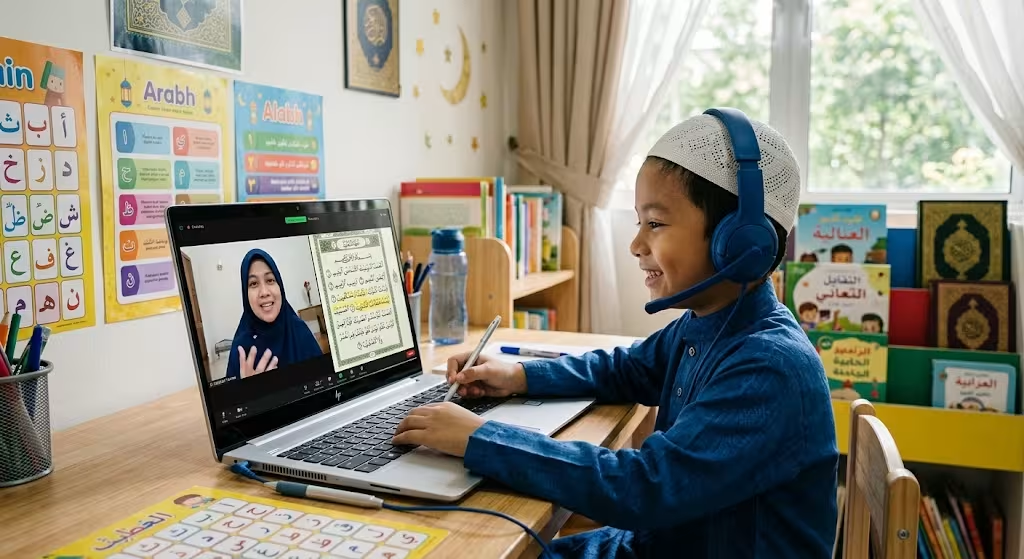
Step 1: Learn Arabic Letters and Sounds
The pronunciation of the letters, like Alif baa, Taa, Jeem, Haa, Khaa and the rest of the Arabic alphabet should be learned.
But it's not enough to be able to identify an alphabet from a visual perspective.
Pronunciation will become a problem as some of the Arabic sounds may not be acquired by those whose first language is English.
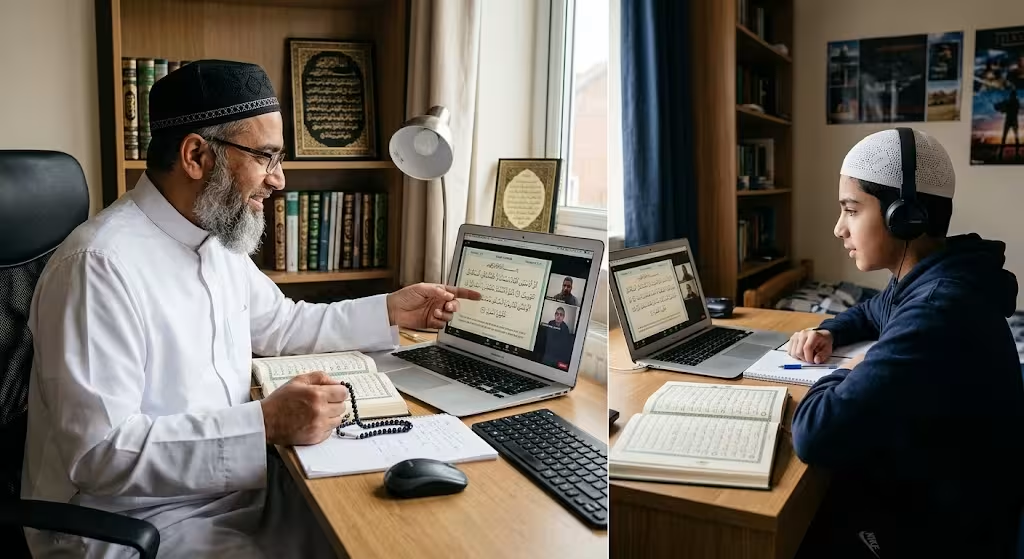
Live teacher will lead the pronunciation of the word as the student makes it correct and also verify if the word is correctly pronounced or not in this case.
That is why Online Quran Classes for kids can help, as the teacher will repeat the sound to the child patiently and correct the child if he/she gets something wrong before proceeding.
Key Focus: Correct pronunciation of Arabic letters from the beginning.
Step 2: Learn to Join Letters and Read Simple Words
When children learn to recognise letters they can start learning about how the letters are connected.
This phase allows students to see the individual letters which are used together when forming a word.
They also study simple vowel signs and the effect it has on the sound of the word.
It is now time to practice, so practice is important.
Novices should avoid just mimicking a sample, and instead read aloud.
It may be helpful for students to revise their understanding from online learning by doing short blocks of practice on a regular basis.
Parents are also asked to help their children to revise the same pages of Qaida from class to class.
Online Quran Classes For Children UK Programme includes Quran Reading, Tajweed, connecting letters of the Arabic alphabet and Quran learning, in a structured learning experience.
Practice Tip: Read aloud daily and revise Qaida pages regularly.
Step 3: Build a Foundation in Tajweed
Doing this is not the correct way to learn Tajweed: it should not be a thing which is imposed on students after they have gained fluency in Quran reading.
Simple Tajweed may be taught if the learner is still learning to read.
A good tutor will:
- Summarize the rule as simply as possible.
- Demonstrate correct recitation
- Have the student say it again.
- Correct mistakes
- Practise the rule in Quranic words
For students already familiar with Arabic alphabet, further courses in the dedicated tajweed class are available to teach further the Tajweed rules and the teaching of the quran.
Teaching Method: Learn Tajweed rules while still learning to read.
Step 4: Move From Qaida to Quran Reading
The next stage after the learner is fluent in letters, joining, basic pronunciation and initial tajweed is that of reading directly from the Quran.
This shift needs to be gradual.
Do not speed-read the questions.
It is very important that reading be accurate not fast.
At this stage, students should be working with:
- Recognising words quickly
- Applying learned pronunciation
- Following basic Tajweed
- A fluent reading without excessive stalling or stumblings.
- Correcting recurring mistakes
- Adopting a daily routine of reading.
Important: Focus on accuracy first, speed will come later.
Step 5: Improve Quran Reading and Fluency
Once the student starts to be able to read basic text from the Quran, she should be able to move onto being fluent with the Quranic text.
There is no 'As fast as you go'.
To read correctly, swiftly and without hesitation and stumble.
For teachers, listening to student errors in recitation and understanding them can be useful advices to improve students' recitation abilities.
Children can benefit especially, from repetition.
A Sahiab Qu'ran can be read to a child any number of times until he or she masters the intonation, then the recitation might be able to be completed.
Lessons might occur at a faster or slower rate for adults.
Some adults are able to identify Arabic letters, but have lost some pronunciation aspects.
Others may have to "Start at the Beginning".
The online quran classes for beginners don't require identical lessons to each learner; why?
Fluency Tip: Use repetition to master intonation and correct pronunciation.
Step 6: Add Memorization Gradually
Memorization can then be introduced when the student has a semi-basis in reading and pronunciation.
For the beginner, short Surahs are commonly used in Salah to start with.
The teacher can choose to break the text into shorter sections to be memorized and also alternate with frequent revisions.
One exercise could be:
- With the teacher read the new verses.
- Pronouncing correctly and Tajweed.
- Repeat each section several times.
- Recite without looking.
- Answers to the previous lesson.
- Test both the complete passage, and portions of it.
The objective of memorizing the Quran is not to develop the spirit of competition as to who can do a certain portion of the Quran as compared to someone else.
It is equally important that whatever is already memorized should be maintained.
Memorization Goal: Quality and retention, not competition.