

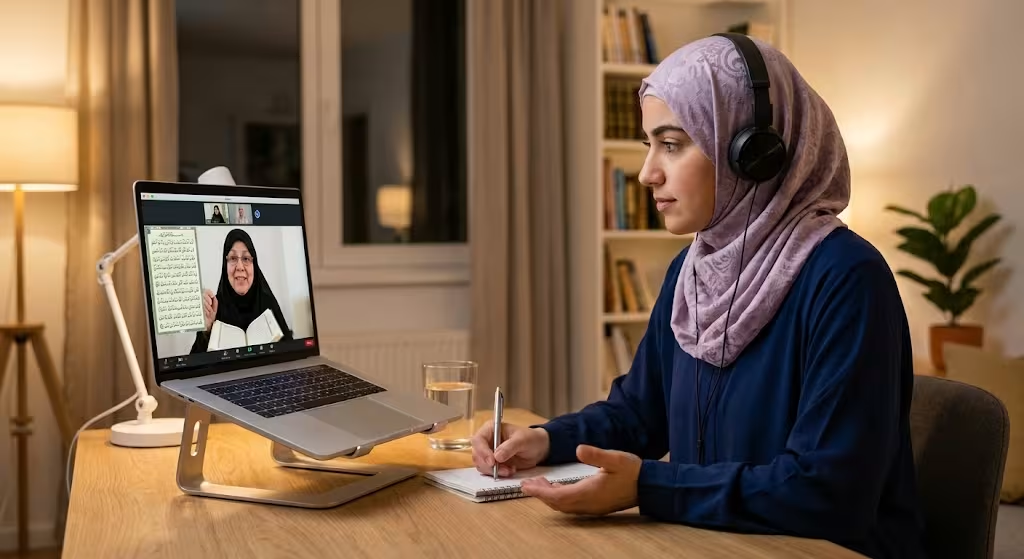
Many adults in the UK can read the Quran, but are not happy with how they sound. Perhaps you learned as a child at the local madrasah, stopped as a teenager, and now read slowly, unsure of the rules, or worried that you have been mispronouncing words for years. The good news is that it is never too late to improve Quran recitation. Adults often improve faster than children, because they can practise with focus and understand why each correction matters. This guide shows you how to diagnose what needs work, a 30-day plan to fix it, and the habits that keep you improving.
The Four Areas of Recitation
"Improving recitation" can mean very different things. It helps to separate it into four areas, each built on the one before:
| Area | What it means | Signs it needs work |
|---|---|---|
| 1. Accuracy | Every letter and vowel is correct | Mixing letters like ح and ه, or adding English vowel sounds |
| 2. Fluency | Reading smoothly without stopping to work out words | Long pauses, re-reading words, losing your place |
| 3. Tajweed | Applying the rules of ghunnah, Madd, qalqalah and stopping | Uneven lengths, missing nasal sounds, stopping in odd places |
| 4. Beauty | A calm, pleasant and consistent tone | Rushing, flat or strained voice, running out of breath |
A common mistake is jumping straight to area 4, copying a famous reciter's melody, while areas 1 to 3 still have errors. A beautiful voice cannot cover a wrong letter.
A Quick Self-Check
Record yourself reciting Al-Fatihah and one longer passage you know, then listen back and ask:
- Are ح, ع, ق, ص and ض clearly different from ه, ء, ك, س and د?
- Are short vowels short and long vowels clearly longer?
- Do you hold a nasal sound on noon and meem with shaddah?
- Do you stop only at the end of verses or at sensible places?
- Do you read at a steady pace, without rushing the familiar parts?
Any "no" tells you where to start. If several answers are "no" for letters and vowels, begin with accuracy before anything else.
Fixing Accuracy and Fluency
Accuracy comes from the makharij, the exit points of the letters. Practise the letters English speakers find hardest, especially the throat letters and the heavy letters. A useful method is to put a sukoon on the letter after a hamza with a fathah (for example أَقْ or أَعْ) and notice exactly where the sound stops; that is where the letter should come from. If many letters are uncertain, a quick review of Noorani Qaida as an adult is nothing to be embarrassed about; it is often the fastest route to clear reading.
Fluency comes from volume: reading a little every day. Stick to one printed Mushaf so your eyes learn the layout, and read slightly below your comfortable speed so you do not build up errors.

Adding Tajweed One Rule at a Time
Trying to apply every Tajweed rule at once is overwhelming. Instead, pick one rule a week, focus on it in all your reading, then add the next:
- Week 1: ghunnah on noon and meem with shaddah.
- Week 2: the natural Madd of two counts.
- Week 3: noon sakinah and tanween; see our guide to noon sakinah and tanween rules.
- Week 4: qalqalah on ق ط ب ج د.
After a month, these rules start to become automatic, and you can move on to longer Madd types and stopping rules.
A 30-Day Plan to Improve Quran Recitation
| Days | Daily focus (10 to 15 minutes) |
|---|---|
| 1 to 7 | Letters: practise five difficult letters a day, then read half a page slowly |
| 8 to 14 | Vowel lengths and ghunnah: read one page, focusing only on these |
| 15 to 21 | Noon and meem rules: mark them in pencil, then read |
| 22 to 28 | Listening and copying: shadow a reciter verse by verse |
| 29 to 30 | Record the same passage as day 1 and compare |
Hearing the difference between day 1 and day 30 is one of the most motivating moments for adult learners.
Improving the Beauty of Your Voice
The Prophet Muhammad ﷺ encouraged a pleasant voice, saying "Beautify the Quran with your voices" (Sunan Abu Dawud). Beauty here does not mean performance; it means calm, clear and heartfelt recitation. Practical steps:
- Choose one clear reciter with a steady pace and copy short sections.
- Breathe before long verses, sitting upright, so you are not forced to stop in the wrong place.
- Slow down. A measured pace sounds more beautiful and leaves room for the rules.
- Reflect on the meaning. When you understand what you recite, your tone naturally follows the message.
Habits That Keep You Improving
- Recite a little every day, ideally at the same time, such as after Fajr.
- Use the Surahs you are polishing in your daily prayers.
- Record yourself once a week and keep the recordings.
- Have your recitation heard by a teacher regularly, because self-study has blind spots; see why learning Tajweed without a teacher is hard.
If you are returning after a long break, our guide to learning Quran as an adult from zero may also help.
Frequently Asked Questions
How can I improve my Quran recitation as an adult?
Work out whether you need to fix accuracy, fluency, Tajweed or tone, then practise 10 to 15 minutes daily, copy a clear reciter, record yourself and have a teacher listen regularly.
Is it too late to fix mistakes I learned as a child?
No. Adults can unlearn old habits with focused practice and regular correction. Many notice a clear difference within a few weeks.
How long does it take to improve Quran recitation?
With daily practice and regular lessons, many adults notice real improvement within a month, and steady progress over the following months.
Should I copy a famous reciter?
Copying a clear, steady reciter is helpful, but focus on accuracy and rules first. Melody should come after the letters and Tajweed are correct.
Can I improve my recitation without a teacher?
You can make progress alone, but a teacher hears mistakes you cannot hear yourself. Combining self-practice with regular lessons works best.
How can I recite the Quran more beautifully?
Slow down, breathe before long verses, keep a steady tone and reflect on the meaning. Beauty grows naturally once accuracy is secure.
 Adults
 Tajweed
 Tajweed