


Almost every parent sees it at some point: a child who was excited about their first lessons starts dragging their feet, logging in late or saying "do I have to?" If you are wondering how to keep kids motivated in online Quran classes, the good news is that a dip in enthusiasm is normal, and it usually has a clear cause. This guide looks at why children lose motivation, what works at each age, and how to respond when your child says they want to stop, so that learning the Quran stays something they love rather than a chore.
Why Children Lose Motivation in Online Quran Lessons
Motivation rarely disappears for no reason. In our experience, most dips come from one of a handful of causes, and each one needs a different response:
- The work feels too hard. A child stuck on the same page of Qaida for weeks starts to feel they are "bad at Quran". Struggle without visible progress drains motivation faster than anything else.
- The work feels too easy or repetitive. Bright children switch off when every lesson looks the same.
- The timing is wrong. A lesson straight after a long school day, after football practice or when friends are playing outside is competing with tiredness and fun.
- The relationship with the teacher is not working. Young children learn from people they like. If they feel nervous, rushed or unseen, they withdraw.
- Quran time feels like a punishment. If lessons are used as a threat ("no tablet until you finish Quran"), children quickly link the Quran with losing something.
- Nobody notices their effort. Children work hard for attention and praise. When effort goes unnoticed at home, it slowly stops.
Before changing anything, spend a week simply watching. Sit in on two or three lessons, notice when your child is bright and when they fade, and ask them gently what they find hardest. The answer usually points straight to the fix.
What Works at Each Age
A five-year-old and a twelve-year-old are motivated by very different things. Use this table as a starting point:
| Age | What motivates them | What to try |
|---|---|---|
| 4 to 6 | Praise, routine, short wins, play | Short lessons, a sticker for each new letter, a parent sitting nearby, celebrating every small step |
| 7 to 9 | Visible progress, small challenges, being "grown up" | A progress chart on the wall, a target such as "finish this Qaida page by Friday", reciting to a grandparent |
| 10 to 12 | Ownership, meaning, fairness | Let them help choose lesson days, set their own goal with the teacher, explain why each rule matters |
| 13 and over | Independence, identity, respect | Treat them as a partner, link lessons to things they care about such as leading prayer at home or understanding what they recite |
The common thread is that motivation grows when a child feels capable. If you are unsure whether your child is ready for structured lessons at all, our guide on what age a child should start learning Quran explains the signs of readiness.
Make Progress Visible
Learning to read the Quran is a long journey, and children cannot feel progress that happens slowly. Your job is to make it something they can see and touch:
- Keep a simple chart. One square for each Qaida lesson, short Surah or Tajweed rule. Your child colours it in when the teacher says it is done.
- Record them once a month. Let your child hear how they recited Al-Fatihah in September and how they recite it now. Children are often amazed at the difference.
- Read the monthly progress report together. Our teachers send parents a monthly progress report. Read the good parts aloud to your child before discussing what to work on.
- Mark the milestones. Finishing the Qaida, reciting the first Surah from memory or starting the Mushaf for the first time all deserve a small family celebration.
If your child is still on the Qaida, it helps to know how long that stage normally takes, so you can set fair expectations. See how long Noorani Qaida takes for a realistic timeline.
Rewards That Help (and Rewards That Backfire)
Rewards can work well, especially for younger children, but the type of reward matters. The aim is to make children proud of their effort, not to turn the Quran into a job they do for payment.
Rewards that usually help:
- Specific praise: "You read that whole line without stopping, well done" is far more powerful than "good boy" or "good girl".
- Time together: choosing the Friday dinner, a trip to the park or an extra bedtime story with a parent.
- Sharing their achievement: reciting a new Surah to grandparents on a video call.
- Small tokens for younger children: stickers, a star chart or a special bookmark for their Qaida.
Rewards that often backfire:
- Large cash payments for each Surah, which can shift the focus to money.
- Comparing them with siblings or cousins ("your sister finished the Qaida at your age").
- Taking away Quran time as a punishment or adding extra lessons as a consequence for bad behaviour.
Alongside any reward, remind children why the Quran is special. The Prophet Muhammad ﷺ said that the one who recites the Quran with difficulty, struggling over it, receives a double reward (Sahih al-Bukhari and Sahih Muslim). Children who find reading hard are often encouraged to hear that their effort itself is valued.
The Teacher Relationship Matters More Than the Method
For children, the teacher is the lesson. A warm teacher who remembers their name, their school and their pet cat can turn a reluctant learner into an eager one. A rushed or stern teacher can do the opposite, however good their recitation.
Signs the relationship is working: your child talks about the teacher at other times, is happy to recite in front of them, and does not freeze when corrected. Signs it is not: tears before lessons, silence during them, or a child who says the teacher "always says I'm wrong".
If you notice the second pattern, speak to the academy. Ask for corrections to be balanced with praise, for the pace to slow down, or for the teacher to spend the first minute of each lesson chatting with your child. Many parents also find that a female Quran teacher helps shy or very young children settle more quickly. You can read more about choosing the right person in our guide to finding an online Quran teacher for children.
When Your Child Says They Want to Stop
Hearing "I don't want to do Quran any more" is painful for a Muslim parent, but it is rarely the end of the story. Try this calm, step-by-step approach:
- Do not react straight away. Thank them for being honest and say you will talk about it later. A heated argument makes the feeling stronger.
- Ask open questions. "What's the hardest part?" or "If you could change one thing about lessons, what would it be?" Children often give surprisingly clear answers.
- Change one thing. A different lesson time, a slower pace, a new Surah to memorise or a short break from homework can be enough.
- Keep the habit, lighten the load. Rather than stopping completely, consider fewer days a week for a month. A small, steady habit is easier to rebuild than one that has been dropped.
- Review after four weeks. Look at the progress report and your child's mood together and decide the next step as a team.
Some children simply need a break from screens after school. If that is the main issue, weekend lessons can work better; see our online weekend Quran classes.
Small Habits at Home That Keep Kids Motivated in Online Quran Classes
- Let them see you recite. Children copy what adults do far more than what adults say.
- Ask them to teach you. "Can you show me how this letter sounds?" turns them from student into expert for a few minutes.
- Play recitation in the car. Hearing the Surahs they are learning makes lessons feel familiar.
- Link it to daily life. Encourage them to recite the Surahs they know in their own prayers, so lessons have an obvious purpose.
- Protect lesson time. Treat it like a swimming lesson or a school club, not something that disappears when anything else comes up.
For practical set-up advice such as a quiet learning space, devices and routines, see our separate tips for online Quran classes for kids.
How We Support Children Who Are Losing Interest
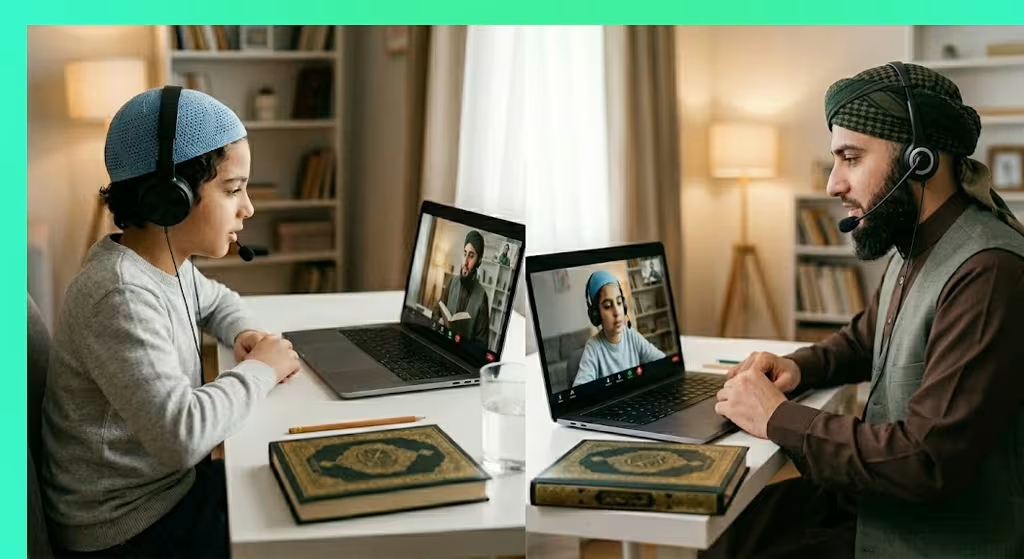
Our online Quran classes for kids are one-to-one, 30-minute lessons with certified male and female teachers, scheduled around UK school times. Parents are welcome to sit in, and every family receives a monthly progress report, so you can spot a dip early and talk to the teacher before it grows. Children usually start with Noorani Qaida and then move on to reading the Quran with Tajweed.
Frequently Asked Questions
How do I keep my child motivated in online Quran classes?
Find out why their motivation has dropped, keep lessons short and achievable, make progress visible with a chart or recordings, and praise effort specifically. Treat Quran time as valuable, never as a punishment.
Is it normal for children to lose interest in Quran lessons?
Yes. Most children go through dips, often after the excitement of the first few weeks or when the Qaida gets harder. A dip is a signal to adjust something, not a sign of failure.
Should I reward my child for learning the Quran?
Small rewards such as stickers, praise and time together can help, especially for younger children. Avoid large cash rewards and comparisons with siblings, which can backfire.
What if my child does not like their Quran teacher?
Talk to your child and sit in on a lesson to see what is happening. Then speak to the academy about the pace, tone or approach. A good relationship with the teacher is one of the biggest drivers of motivation.
Should I let my child stop Quran classes if they want to?
Try reducing the load before stopping altogether, for example fewer days a week or a different lesson time for a month. Keeping a small habit going is easier than restarting from nothing.
How can I tell if my child is making progress?
Read the monthly progress report, sit in on a lesson now and then, and compare recordings of their recitation a few months apart.
 Kids
 Kids
 Kids