


Many adults in the UK can read the Quran but know their recitation is not quite right. Some learned as children and stopped at 12; others converted to Islam or started late. Tajweed classes for adults are designed for exactly this situation: they take you from wherever you are now to clear, correct recitation, without treating you like a child. This guide explains what you actually learn in adult Tajweed classes, level by level, how to work out where you should start, how much time it really takes alongside work and family, and what to look for in a teacher.
Who Adult Tajweed Classes Are For
- Returners who learned at a mosque as children but never studied the rules properly.
- Parents who want to read correctly so they can help their children.
- Reverts who have learned to read and now want to recite properly.
- Imams-in-the-making and anyone who leads prayers at home or in the community.
- Huffaz who memorised as children and want to polish their Tajweed.
Adults bring real strengths: focus, discipline and the ability to understand why a rule exists. They also bring old habits, which is why one-to-one correction matters so much.
What You Learn in Tajweed Classes for Adults, Level by Level
| Level | Who starts here | What you learn |
|---|---|---|
| 1. Reading foundations | Adults new to Arabic, or very unsure readers | The letters in every position, vowels, sukoon, shaddah and stopping signs, usually through Noorani Qaida |
| 2. Basic Tajweed | Adults who can read but make letter mistakes | Correct exit points of letters, heavy and light letters, ghunnah, short Surahs recited correctly for Salah |
| 3. Intermediate | Adults who read fluently but do not know the rules | Noon sakinah and tanween, meem sakinah, lam sakinah, qalqalah, connecting hamza, where to stop and start |
| 4. Advanced | Fluent readers who know the basic rules | Letter characteristics, all types of Madd and Idgham, and applying every rule consistently across whole Surahs |
After level 4, some adults continue to beautify their recitation in a Qirat course or work towards an Ijazah with a chain of transmission; see our explainer on what an Ijazah in the Quran is.
Where Should You Start? A Quick Self-Check
- Can you read any line of the Quran without spelling words out? If not, start at level 1.
- Do you clearly separate ح from ه, ع from ء, and ق from ك? If not, level 2.
- Do you know when a noon is hidden, merged or pronounced clearly? If not, level 3.
- Can you name the types of Madd and hold each for the right length? If not, level 4 is your next step.
A teacher will confirm your level in the first lesson. Do not worry about starting "too low": revising the foundations quickly is much better than building on shaky ground.
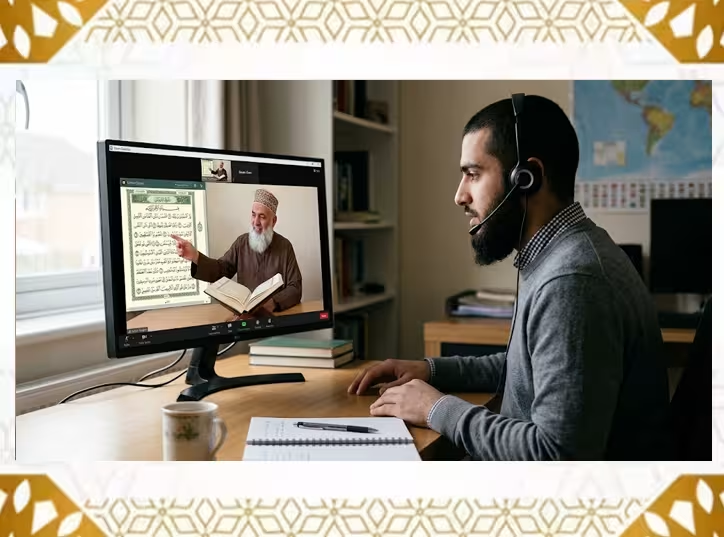
What an Advanced Tajweed Course Adds
Advanced Tajweed is less about new rules and more about precision. Adults at this level work on:
- The permanent characteristics of each letter, such as which letters are whispered, which are strong, and which are heavy.
- The finer types of Idgham and Madd, and why reciters choose certain lengths.
- Consistency: applying every rule correctly across a whole page, not just in practice examples.
- Hidden mistakes that change no words but affect the quality of recitation.
Our guide to advanced Tajweed rules goes into more detail.
How Much Time Adults Really Need
Most working adults do well with three 30-minute lessons a week and about ten minutes of practice on the other days. Progress depends far more on consistency than on the number of hours. Typical patterns we see:
- Fixing letter sounds (level 2) often takes a few months of steady practice.
- Learning and applying the intermediate rules usually takes several more months.
- Advanced Tajweed is an ongoing refinement rather than a quick course.
Adults with busy jobs often prefer early-morning, lunchtime or evening slots; our guide to Quran classes for working adults has ideas for fitting lessons around work.
Common Worries Adults Have
- "I am embarrassed about my level." One-to-one lessons are private. Teachers work with adults at every stage, including complete beginners.
- "I have bad habits from childhood." They can be fixed. A teacher identifies your personal mistakes and gives you targeted practice.
- "I would prefer a female teacher." Many women do; you can choose one of our female Quran teachers.
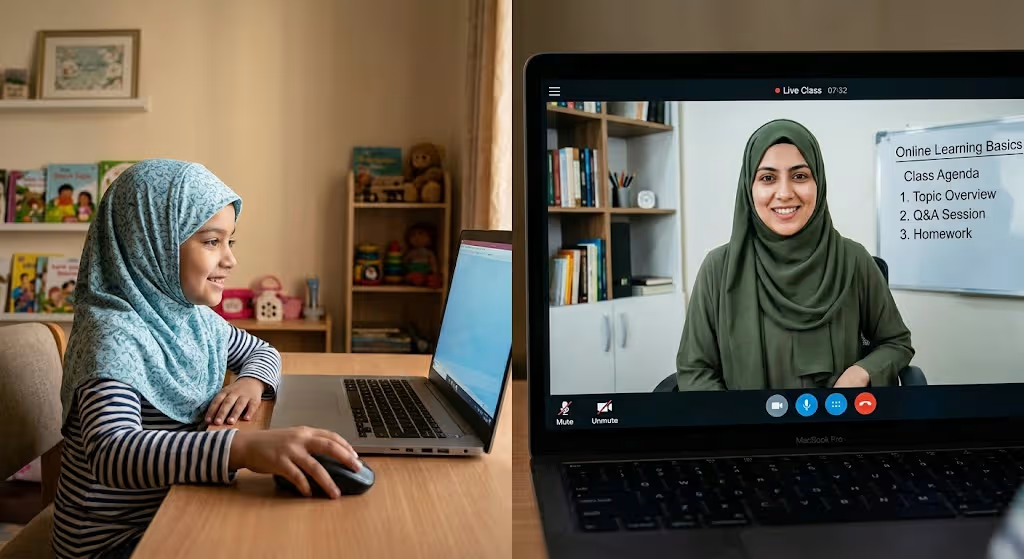
- "Can adults really improve their recitation online?" Yes. Tajweed is learned by listening and correction, which works very well in a live one-to-one video lesson.
Choosing the Right Tajweed Class
- One-to-one lessons, so the teacher hears every letter you recite.
- A teacher with proper Tajweed training, ideally with an Ijazah.
- A clear plan: which level you are on and what comes next.
- Regular feedback, such as monthly progress reports.
- Times that fit around your work and family.
If you want practical exercises between lessons, our guide to meem sakinah rules includes a simple practice method, and our guide to noon sakinah and tanween rules covers one of the first intermediate topics.
Frequently Asked Questions
What do you learn in Tajweed classes for adults?
Correct letter sounds, heavy and light letters, ghunnah, the rules of noon and meem sakinah, qalqalah, Madd and stopping, then advanced precision and consistency.
Are there Tajweed classes for adults in the UK?
Yes. Online one-to-one Tajweed classes let UK adults learn from qualified teachers at times that fit around work and family.
How long does it take an adult to learn Tajweed?
Fixing letter sounds often takes a few months, and learning the main rules several more. Consistent practice matters more than speed.
Can adults improve their Quran recitation online?
Yes. Live one-to-one lessons let the teacher hear and correct every mistake, which is how Tajweed has always been taught.
What is an advanced Tajweed course?
It covers letter characteristics, all types of Madd and Idgham, and applying every rule consistently across whole Surahs.
Do I get a certificate for Tajweed?
Formal certification in Quran recitation is an Ijazah, which is a separate, longer course with a qualified teacher.
 Tajweed
 Adults
 Adults