


If you have ever heard a reciter read a word slightly differently from your own Mushaf, you have met the Qiraat. The 10 Qiraat of the Quran are the ten authentic, mass-transmitted ways of reciting the Quran, each preserved through a chain of teachers going back to the Prophet Muhammad ﷺ. For many UK Muslims, who have only ever heard one recitation, this can be surprising and even worrying. This guide explains, simply and accurately, what the Qiraat are, who the ten reciters were, how they differ, and why this variety is part of how the Quran was revealed and preserved.
What Are the Qiraat?
The word qira'ah (plural qiraat) means "a reading" or "a recitation". In Quranic studies, it refers to a complete method of reciting the Quran that has been transmitted by large numbers of reciters in every generation, so widely that it could not have been invented or altered.
The Prophet ﷺ said that the Quran was revealed in seven ahruf (modes), so recite whatever is easy for you (Sahih al-Bukhari and Sahih Muslim). The Qiraat preserve this variety. Note that the "seven ahruf" in the hadith are not the same thing as the "seven Qiraat"; scholars have discussed the relationship between them at length, and it is a topic best studied with a qualified teacher.
The 10 Qiraat of the Quran and Their Narrators
| # | Reciter (Qari) | City | Two main narrators |
|---|---|---|---|
| 1 | Nafi' | Madinah | Qalun and Warsh |
| 2 | Ibn Kathir | Makkah | Al-Bazzi and Qunbul |
| 3 | Abu 'Amr | Basrah | Ad-Duri and As-Susi |
| 4 | Ibn 'Amir | Damascus | Hisham and Ibn Dhakwan |
| 5 | 'Asim | Kufa | Shu'bah and Hafs |
| 6 | Hamzah | Kufa | Khalaf and Khallad |
| 7 | Al-Kisa'i | Kufa | Abu al-Harith and Ad-Duri |
| 8 | Abu Ja'far | Madinah | Ibn Wardan and Ibn Jammaz |
| 9 | Ya'qub | Basrah | Ruways and Rawh |
| 10 | Khalaf al-'Ashir | Baghdad | Ishaq and Idris |
The first seven are often called "the seven Qiraat", after the scholar Ibn Mujahid gathered them in the 4th Islamic century. Later, the great scholar Ibn al-Jazari confirmed that the remaining three meet the same strict conditions, giving the ten that are studied today.
How Scholars Decide a Reading Is Authentic
Scholars of the Qiraat, most famously Ibn al-Jazari, set three conditions that a reading must meet to be accepted as Quran:
- An authentic, mass-transmitted chain of reciters going back to the Prophet ﷺ.
- Agreement with Arabic grammar, in at least one valid way.
- Agreement with the script of one of the Mushafs sent out by the Caliph 'Uthman, even if only implicitly.
A reading that fails any of these is not recited as Quran in prayer. The ten Qiraat all meet these conditions, which is why they are taught with such confidence.
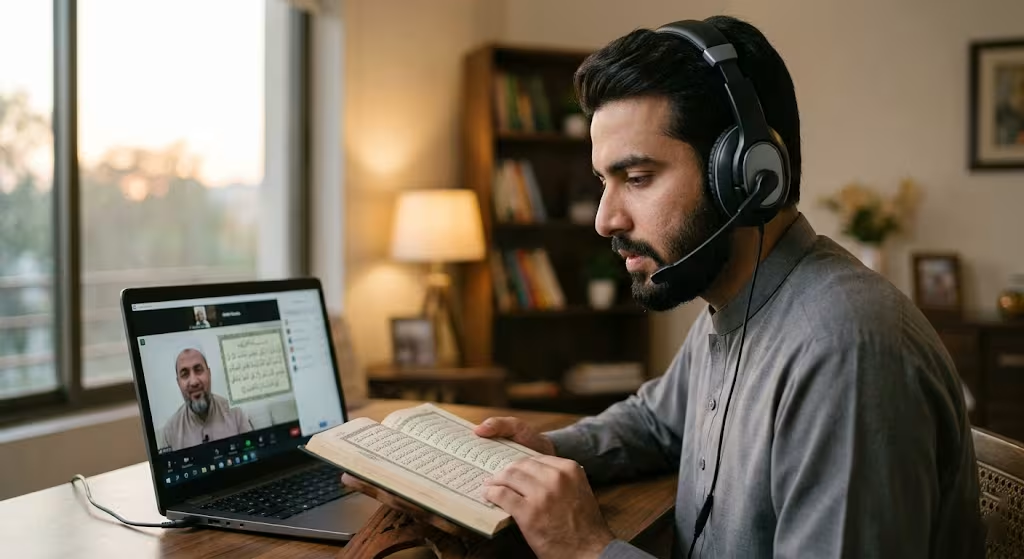
Qira'ah, Riwayah and Tariq: The Three Levels
- Qira'ah: the reading of one of the ten Imams, such as the Qira'ah of 'Asim.
- Riwayah: the narration of one of that Imam's two main students, such as the Riwayah of Hafs from 'Asim.
- Tariq: a later route of transmission through a particular chain of teachers. This is why some details, such as the length of certain Madd, can vary slightly even within Hafs.
How Do the Qiraat Differ?
Most differences are in pronunciation, for example the length of a Madd, whether a vowel is tilted (imalah), or how a hamza is pronounced. Some differences are in the form of a word, and occasionally they add a shade of meaning. A well-known example is in Al-Fatihah:
- مَالِكِ يَوْمِ الدِّينِ "Master of the Day of Judgement", as read by 'Asim (including Hafs), Al-Kisa'i, Ya'qub and Khalaf.
- مَلِكِ يَوْمِ الدِّينِ "King of the Day of Judgement", as read by the other reciters.
Both readings are authentic and both are true: Allah is both the Master and the King of that Day. Scholars see such differences as enriching the meaning, not contradicting it.
Where Each Recitation Is Heard Today
- Hafs 'an 'Asim: by far the most widespread worldwide, and the recitation used in almost all UK mosques and printed Mushafs.
- Warsh 'an Nafi': common in much of North and West Africa.
- Qalun 'an Nafi': used in parts of North Africa, including Libya.
- Ad-Duri 'an Abu 'Amr: heard in parts of Sudan and neighbouring regions.
In UK cities with large North African communities, you may hear Warsh in some mosques. It is completely valid; it is simply a different authentic narration.
Should Ordinary Learners Study the Qiraat?
For most learners, the priority is to recite one narration, usually Hafs, accurately and beautifully. Studying the other Qiraat is an advanced specialism, usually undertaken after:
- Reading fluently with full Tajweed.
- Memorising a large part of the Quran, or all of it.
- Completing an Ijazah in at least one narration; see what an Ijazah in the Quran is.
That said, a basic awareness of the Qiraat is valuable for everyone. It protects against confusion when you hear a different recitation and deepens your appreciation of how carefully the Quran has been preserved.
Qirat, Qiraat and Tajweed: Clearing Up the Terms
In everyday UK usage, "Qirat" often simply means beautiful, skilled recitation, while "the Qiraat" refers to the ten readings described here. Tajweed is the set of rules for pronouncing the Quran correctly, which applies within every Qira'ah. If you are still building those foundations, our Tajweed course and our guide to advanced Tajweed rules are good next steps, and our Ijazah course is for those aiming for certification.
Frequently Asked Questions
What are the 10 Qiraat of the Quran?
They are ten authentic methods of reciting the Quran, named after Nafi', Ibn Kathir, Abu 'Amr, Ibn 'Amir, 'Asim, Hamzah, Al-Kisa'i, Abu Ja'far, Ya'qub and Khalaf, each with two main narrators.
Which Qira'ah is most common in the UK?
Hafs 'an 'Asim, which is used in almost all UK mosques and printed Mushafs.
Are the different Qiraat all authentic?
Yes. Each is mass-transmitted with chains of teachers going back to the Prophet ﷺ, and scholars accept all ten.
Do the Qiraat change the meaning of the Quran?
Most differences are in pronunciation. Where wording differs, the meanings complement each other, as with مَالِكِ and مَلِكِ in Al-Fatihah.
Are the seven Qiraat the same as the seven ahruf?
No. The seven ahruf are mentioned in hadith; the seven Qiraat were gathered by the scholar Ibn Mujahid centuries later. Scholars discuss how they relate.
Should beginners learn the other Qiraat?
Not at first. Beginners should master one narration, usually Hafs, with Tajweed. The other Qiraat are an advanced specialism.
 Tajweed
 Tajweed
 Tajweed