


Noorani Qaida lessons take a learner from the Arabic alphabet to reading words from the Quran, one small step at a time. But if you are a parent watching your child turn the pages, or an adult starting from zero, it is not always clear what each lesson is teaching or why it matters. This guide walks through the Qaida lesson by lesson, explains the key skill in each part, points out the mistake learners most often make there, and gives you a quick check you can do at home.
How the Qaida Is Built
The Qaida is designed like a staircase. Each lesson adds exactly one new idea, and every page reuses everything learned before. That is why rushing the early lessons causes problems later: a learner who is unsure of a letter's sound in lesson 1 will stumble again in every lesson that follows.
The rule of thumb used by experienced teachers is simple: move on only when the current page can be read smoothly, without hesitation. For realistic timings, see our guide on how long Noorani Qaida takes.
Noorani Qaida Lessons at a Glance
| Part | What is taught | Most common mistake |
|---|---|---|
| Single letters | The Arabic letters (28, or 29 when hamza is counted) and their correct sounds | Mixing similar sounds, such as ح and ه, or س and ص |
| Joined letters | How letters change shape when joined | Not recognising a letter in its middle form |
| Disjointed letters | Letters read by their names, as at the start of some Surahs | Shortening names that should be stretched |
| Short vowels | Fathah, kasrah and dammah | Adding English vowel sounds, such as "ay" instead of a short "a" |
| Tanween | Double vowels with an "n" sound | Forgetting the "n" at the end |
| Standing vowels and long vowels | Stretching sounds for two counts | Stretching too short or too long |
| Soft letters | و and ي with sukoon after a fathah | Turning them into English "ow" or "ay" |
| Sukoon | Letters with no vowel | Adding a small vowel after the letter |
| Shaddah | Doubled, stressed letters | Not stressing the letter enough |
| Final exercises | Quranic words, ghunnah and simple Tajweed | Reading quickly before the rules are secure |
The Letter Lessons: Single, Joined and Disjointed
Single letters are the foundation. The goal is not just recognising each shape but producing each sound from the right place in the mouth and throat. English has no equivalent for several letters, including ع, ح, خ, غ and ق, so these take extra practice.
Joined letters show how letters look at the start, middle and end of a word. Many letters lose their "tails" when joined, and some (like ب, ت and ث) differ only by their dots.
Disjointed letters (huroof muqatta'at) are read by their names, such as الم at the start of Surah Al-Baqarah. They give learners their first taste of reading something exactly as it appears in the Quran.
Home check: point to random letters on the page, out of order. If your child can say each sound instantly, they are ready to move on.

The Vowel Lessons: Harakat, Tanween and Long Vowels
Short vowels (fathah, kasrah, dammah) turn letters into syllables. This is usually the moment learners start to feel they are "reading". The key is keeping vowels short and pure.
Tanween adds an "n" sound at the end: "an", "in" and "un". It looks small on the page but appears constantly in the Quran, and later it becomes the basis of important Tajweed rules covered in our guide to noon sakinah and tanween rules.
Standing vowels and long vowels teach learners to stretch a sound for about two counts, using the letters alif, waw and ya. Getting this length right early prevents one of the most common errors in Quran recitation.
Home check: ask your child to read a line and listen only for vowel length. Short vowels should be short; long ones should be clearly longer.
Soft Letters, Sukoon and Shaddah
Soft letters (leen) are و and ي with a sukoon after a fathah, giving sounds such as "aw" and "ay". They should be gentle and not exaggerated.
Sukoon means a letter has no vowel. Learners must stop on the letter cleanly, which is harder than it sounds for English speakers, who tend to add a tiny "uh" afterwards.
Shaddah doubles a letter: it is read once with a sukoon and once with the vowel, giving it extra stress. When shaddah appears on noon or meem, a nasal sound (ghunnah) is held for about two counts.
This middle section is where many learners slow down. That is normal. It is also the part that most affects how well someone will eventually read the Quran, so patience here pays off.
The Final Lessons: Putting It All Together
The last lessons combine everything: longer words, words taken directly from the Quran, and simple Tajweed such as ghunnah, the rules for noon and meem with sukoon, and how to stop at the end of a verse. By the final page, a learner should be able to read unfamiliar Quranic words slowly but correctly.
The step after the Qaida is reading from the Mushaf itself, usually starting with the short Surahs of Juz Amma. Our article on the learning path from Qaida to Quran explains what that transition looks like.
Tips for Parents Following Along
- Ask which page your child is on each week, and listen to them read it once at home.
- Praise accuracy, not speed. Slow and correct is far better than fast and careless.
- Expect revision. If the teacher goes back a few pages, it is to make the foundations solid, not a step backwards.
- Keep the same printed edition. Switching editions mid-way can confuse lesson numbers and page layouts.
If you would like ideas for teaching young children, our guide to Noorani Qaida for kids has more tips.
Learning the Qaida Online
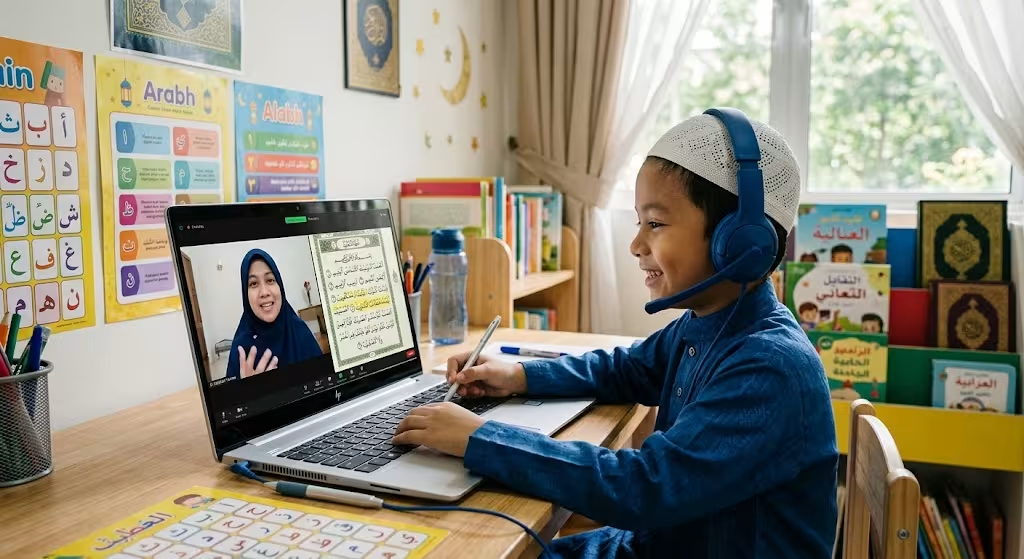
Because the Qaida is all about correct sounds, it is best learned with a teacher who hears every letter. Our Noorani Qaida course is taught one-to-one in 30-minute lessons by certified male and female Quran teachers, on UK time. Parents can sit in, and every learner receives a monthly progress report showing which lessons are complete. Adults starting from zero are very welcome too; see our Quran classes for beginners.
Frequently Asked Questions
How many lessons are in Noorani Qaida?
Most editions have 16 or 17 lessons. The numbering varies slightly, but every edition teaches the same skills in the same order.
What is taught in Noorani Qaida lesson 1?
Lesson 1 teaches the single Arabic letters and how to pronounce each one from the correct place in the mouth and throat.
Which Noorani Qaida lesson is the hardest?
Many learners find the sukoon and shaddah lessons hardest, because English speakers are not used to stopping on a letter or stressing it.
Should my child repeat a lesson?
Yes, if they cannot yet read it smoothly. Repeating a lesson now saves time later.
What comes after Noorani Qaida?
Reading from the Mushaf, usually beginning with the short Surahs in Juz Amma, along with basic Tajweed.
Can adults learn Noorani Qaida?
Yes. Adults often move through the Qaida faster than children because they can practise independently.
 Guides
 Kids
 Kids