

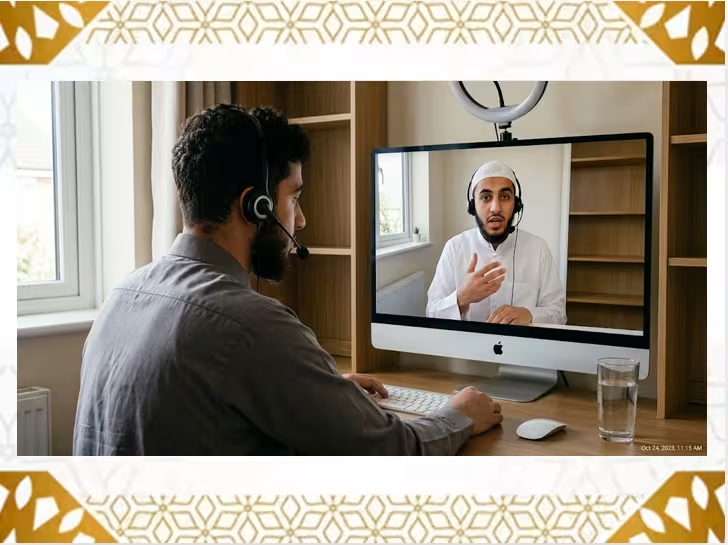
Online Quran tuition in the UK has become the first choice for many families and adults, but if you have never tried it, it can be hard to picture. What actually happens in a lesson? How does the teacher correct you through a screen? What do you do between lessons, and how do you know it is working? This guide takes you inside one-to-one online Quran tuition: a 30-minute lesson minute by minute, a typical week and month, the tools teachers use, and how it compares with a tutor coming to your home.
What One-to-One Online Quran Tuition Means
One-to-one means the whole lesson is for one learner: one teacher, one student, nobody else waiting for a turn. Online means it happens by live video call, so the teacher can be anywhere and you learn from home. Together, they solve the two biggest problems of traditional classes in the UK: too little individual attention, and timetables that clash with school and work. Parents often ask where to find one-to-one online Quran lessons for children; the format works for every age, from five-year-olds learning letters to adults polishing their Tajweed.
A 30-Minute Lesson, Minute by Minute
| Time | What happens |
|---|---|
| 0 to 3 minutes | Greeting, quick check of sound and camera, a word about the learner's week |
| 3 to 10 minutes | Revision: the learner reads the previous lesson; the teacher listens for anything forgotten |
| 10 to 20 minutes | New material: a new Qaida page, Tajweed rule, passage or memorisation portion |
| 20 to 27 minutes | Guided practice: the learner reads the new part aloud, with correction on every mistake |
| 27 to 30 minutes | Summary and a small task to practise before the next lesson |
The key difference from a group class is the middle section. In one-to-one tuition the learner is reading aloud and being corrected for most of the lesson, rather than waiting while others take turns.
How Teachers Correct You Through a Screen
- Listening closely. With good headphones, teachers hear subtle differences in letters and vowel lengths clearly.
- Modelling. The teacher recites a word, the learner repeats, and they go back and forth until it is right.
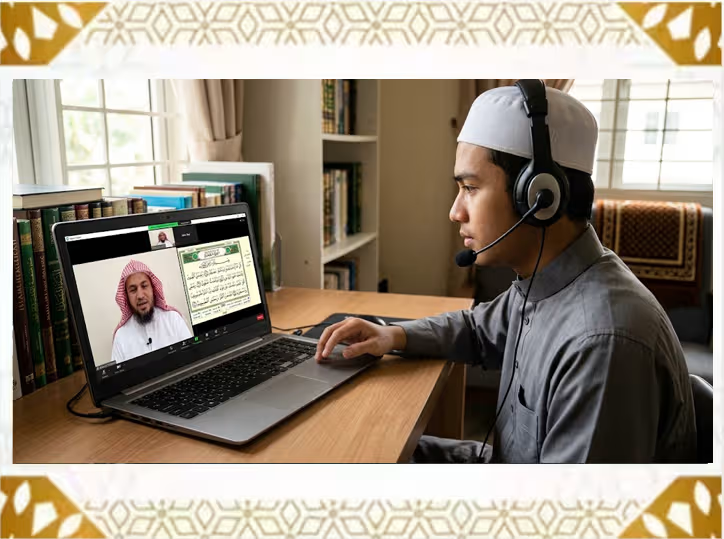
- Shared pages. The teacher can show the exact page on screen and point to the letter or sign being discussed.
- Watching the mouth. For letters made with the lips or tongue tip, the camera lets the teacher see and show how a sound is formed.
A Typical Week and Month
Each week: three to five lessons at fixed times, plus about ten minutes of practice on other days, such as reading the last page or listening to the Surah being memorised. Families often ask whether lessons can be booked around a child's school timetable or a working day; with online tuition, after-school, evening, early-morning and weekend slots on UK time are all common.
Each month: a review of what has been covered and what comes next. We send families a monthly progress report, so parents can see exactly where their child is without sitting in on every lesson.
What You Can Learn Through One-to-One Tuition
- Reading from scratch with Noorani Qaida.
- Correct recitation with a Tajweed course.
- Memorisation through a Hifz programme.
- Understanding the meaning through Tafseer and translation.
- Duas, manners and the basics of faith through Islamic Studies.
Online Tuition or a Tutor at Home?
| Online one-to-one | Home tutor | |
|---|---|---|
| Choice of teachers | Wide, including female teachers | Limited to who lives nearby |
| Timing | Early morning to late evening, weekends | Depends on the tutor's travel |
| Cost | No travel costs | Often higher per hour |
| Face-to-face presence | By video | In person |
Both can work well. Many families who started with a home tutor switch to online tuition for the wider choice of qualified teachers and easier scheduling. Our guide to online versus in-person Quran classes looks at this in more depth.
Getting the Most From Online Tuition
- Keep the same slot every week so lessons become a habit.
- Use headphones for clear sound in both directions.
- Prepare the book and space before the lesson starts.
- Do the small task between lessons; ten minutes makes a big difference.
- For children, sit in now and then, especially in the first few weeks.
Choosing the right teacher matters most of all; our guide on finding the right Quran teacher in the UK covers what to look for.
Who Online Quran Tuition UK Suits Best
- Beginners of any age, because every letter needs individual checking.
- Shy children and self-conscious adults, who read more confidently without an audience.
- Hifz students, who need a teacher to hear new memorisation and revision almost daily.
- Families without a good local class, or whose local class clashes with school, clubs or work.
- Sisters and daughters who prefer a female teacher, which is much easier to arrange online.
It may suit less well if a learner mainly wants the social side of a group, though many families combine a weekend community class with short one-to-one lessons.
What Online Quran Tuition Costs
Prices across the UK vary with lesson length and the number of lessons. Our one-to-one plans are £20 to £40 a month for one to five 30-minute lessons a week, or £35 for a weekend plan, listed on our fees page. Compare the price per 30-minute one-to-one lesson when looking at other options.
Frequently Asked Questions
How does one-to-one online Quran tuition work?
A qualified teacher meets one learner by live video. Lessons combine revision, new material and reading aloud with instant correction, followed by a small practice task.
Where can I find one-to-one online Quran lessons for children?
Online academies offer one-to-one lessons for children with qualified teachers. Book a free trial to meet the teacher and see how your child responds.
Can I book lessons around my child's school timetable?
Yes. Online tuition offers after-school, evening and weekend slots on UK time.
Are online Quran classes available with flexible timings?
Yes. Lessons can run from early morning to late evening, on weekdays or at weekends, depending on the plan you choose.
How long is each lesson?
Our lessons are 30 minutes, which suits both children and adults.
Is online tuition as good as a home tutor?
For Quran reading, which depends on listening and correction, a good online teacher can be just as effective, with a wider choice of teachers and times.
 Guides
 Guides
 Fees