

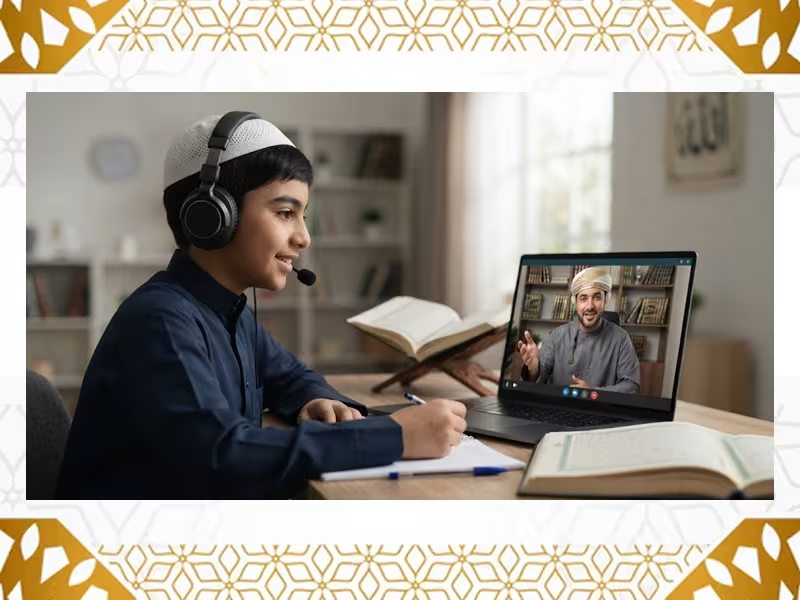
More and more British Muslim parents want their children to memorise the Quran, but very few want them to fall behind at school. The good news is that Hifz for kids in the UK does not have to mean choosing between the two. Thousands of children complete Hifz while attending ordinary primary and secondary schools. It takes planning, a steady routine and the right support. This guide covers the main routes families take, how to tell if your child is ready, how to plan around the school year, and the warning signs that a child needs a lighter load.
Hifz for Kids UK: Three Routes Families Take
| Route | How it works | Suits |
|---|---|---|
| Evening Hifz class at a local mosque or madrasah | Group class after school, often two to three hours, several days a week | Families who live close by and want a community setting |
| Online one-to-one Hifz | A teacher hears the child's lesson and revision in a short daily video lesson at home | Busy families, children who need individual attention, areas without a local Hifz class |
| Full-time Hifz school | Hifz is the main focus, often alongside a reduced school curriculum | Families ready for a bigger commitment, usually for a limited period |
Many families combine routes, for example online lessons during the school term and a local summer Hifz programme in the holidays.
Can You Take a Child Out of School for Hifz?
This is one of the most common questions parents ask. In England, taking a child out of school during term time needs the headteacher's permission, which is only given in exceptional circumstances, and unauthorised absence can lead to fines. Rules are similar across the rest of the UK. Families who want full-time Hifz usually choose a registered independent school with a Hifz programme or elective home education instead. For most families, though, Hifz alongside normal school is the more practical path.
Is Your Child Ready for Hifz?
Age matters less than readiness. Look for these signs:
- Fluent reading. Your child can read from the Mushaf smoothly, without spelling out words.
- Basic Tajweed. They know the main rules such as ghunnah, Madd and noon sakinah, so they memorise correctly from the start.
- Some short Surahs already memorised. A child who has learned Juz Amma has shown they can memorise and retain.
- Willingness. They are keen, or at least happy, to try. Hifz forced on an unwilling child rarely lasts.
- Room in the week. There is a realistic daily slot that does not depend on cutting sleep.
If reading is not yet fluent, a few months of Tajweed lessons first will make Hifz faster and more accurate. Our guide on what age a child should start learning Quran covers the earlier stages.

A Typical School-Day Routine
- Before school (10 minutes): read the new portion several times while the mind is fresh.
- After school (30 minutes): a short break and snack, then the Hifz lesson, where the teacher hears the new portion and recent revision.
- After homework (15 to 20 minutes): revise older portions with a parent listening.
- Weekends: one day for revision only, and one lighter day or a rest.
Short, daily sessions work far better than long sessions on a few days. Most children doing Hifz benefit from five lessons a week, because new memorisation and revision both need to be heard; see our guide on how many Quran lessons a week.
Planning Around the School Year
School pressure changes through the year, and a good Hifz plan changes with it:
- September to December: a good time to start or push forward, while routines are fresh.
- Year 6 SATs (May): reduce new memorisation for a few weeks and focus on revision.
- Years 10 and 11 (GCSEs): many families slow new memorisation and protect revision so nothing is lost; some plan to finish Hifz before Year 10 begins.
- Summer holidays: an excellent time to increase the daily target or catch up on revision.
- Ramadan: children are often especially motivated; it can be a time for extra revision and listening.
The Parent's Role
Parents do not need to be Huffaz themselves to support Hifz. What makes the biggest difference is:
- Listening to revision with the Mushaf open, even if you just follow the words.
- Protecting the routine from screens, visitors and late nights.
- Talking to the teacher regularly and reading the progress report.
- Celebrating milestones such as completing a Juz.
- Keeping perspective: Hifz is a long journey, and steady progress matters more than speed.
The reward continues long after the hard work. The Prophet Muhammad ﷺ said that when a person dies their deeds come to an end except for three, one of which is a righteous child who prays for them (Sahih Muslim). A child who carries the Quran in their heart is a gift to their parents in this life and the next.
Warning Signs Your Child Needs a Lighter Load
- Tears, anxiety or arguments before most Hifz sessions.
- Falling behind at school or regularly missing homework.
- Older portions being forgotten faster than new ones are learned.
- Constant tiredness or late bedtimes.
If you see these signs, reduce the new target, give revision more time, or take a short revision-only break. Our guide on how to keep kids motivated in online Quran classes has more ideas for reluctant learners.
How Online Hifz Fits Around School
For many UK families, online Hifz is the easiest way to combine memorisation and school, because a 30-minute lesson at home replaces travel to an evening class. Our Hifz programme offers one-to-one lessons with certified male and female Quran teachers, timed around UK school hours. Parents can sit in, and every family receives a monthly progress report. Girls can also read about our Quran Hifz classes for ladies, and families comparing options can see our Quran memorisation course in the UK overview.
Frequently Asked Questions
Can my child do Hifz alongside school in the UK?
Yes. Many children memorise for 30 minutes to an hour on weekdays after school, with revision at home, and complete Hifz over several years.
What is the best age to start Hifz?
When your child reads the Quran fluently with basic Tajweed, which is often between about 7 and 10. Readiness matters more than a specific age.
Can I take my child out of school to do Hifz?
In England, term-time absence needs the headteacher's permission and is only allowed in exceptional circumstances. Families wanting full-time Hifz usually choose a registered Islamic school or home education instead.
How many hours a day should a child spend on Hifz?
Around 30 minutes to an hour on school days is common, split between new memorisation and revision.
Is online Hifz effective for children?
Yes. Hifz depends on a teacher hearing the child recite, which works well one-to-one online, and it saves travel time on school days.
What should we do during GCSE year?
Many families reduce new memorisation and protect revision during exam years, then pick up the pace again afterwards.
 Hifz
 Hifz
 Kids