

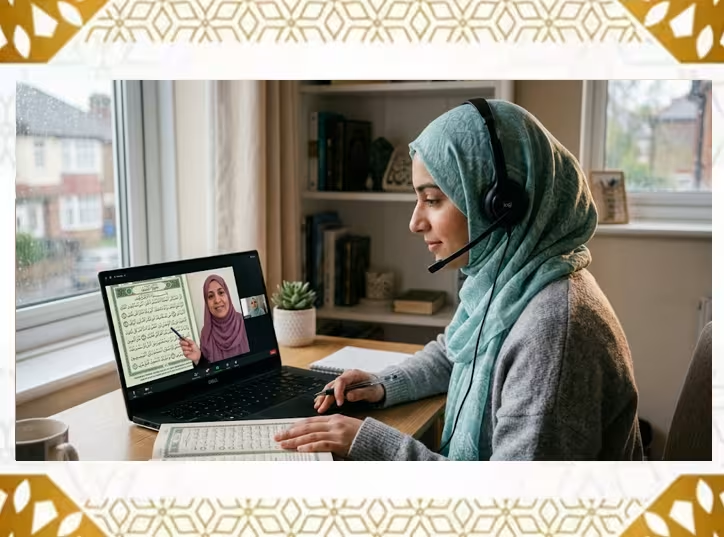
If you want to learn Quran online in the UK, the hardest part is often knowing where to begin. There are hundreds of academies, apps and videos, and every website promises the same things. This roadmap cuts through the noise. It walks you through six decisions in the right order, from who is learning and what the goal is, to choosing a teacher and planning the first ninety days, and then shows realistic milestones at three, six and twelve months for each of the most common goals.
Decision 1: Who Is Learning?
The right approach depends on the learner:
- Young children (4 to 7): short, playful lessons, lots of praise, a parent nearby.
- Older children (8 to 13): clear weekly targets, a teacher they like, progress they can see.
- Teenagers: respect, independence and lessons that fit around school and exams.
- Adults: privacy, flexible times and a teacher who understands busy lives; see our guide to learning Quran as an adult from zero.
Decision 2: What Is the Goal?
| Goal | Where it starts | Main course |
|---|---|---|
| Read the Quran from scratch | The Arabic letters | Noorani Qaida |
| Read correctly with Tajweed | Correct letter sounds, then rules | Tajweed course |
| Memorise Surahs or the whole Quran | Fluent reading first | Hifz / memorisation |
| Understand what you recite | Meanings of what you pray | Tafseer and translation |
Many learners combine goals, for example reading with Tajweed while memorising short Surahs. Pick one main goal for the first three months so progress is clear.
Decision 3: Find the Real Starting Level
A free trial class is the easiest way. A good teacher will listen to you or your child read for a few minutes and say exactly where to start. Be honest about gaps: starting slightly lower and moving quickly is better than skipping foundations and stalling later.

Decision 4: Choose the Right Format
- One-to-one or group? One-to-one gives far more reciting and correction time; groups add company and cost less. Our comparison of online and in-person Quran classes explains the wider choice.
- Male or female teacher? Many sisters and families with daughters prefer a female teacher; you can choose.
- Lesson length? Thirty minutes suits most children and adults.
- When? After school, early morning, lunchtime, evenings or weekends, on UK time.
Decision 5: Set a Schedule You Can Keep
Three lessons a week is the most common starting point for children and working adults; Hifz students usually need five. Fix the days and times, put them in the calendar and treat them like any other appointment. Our guide on how many Quran lessons a week covers this in detail.
Decision 6: Set Up for Online Learning
- A laptop or tablet with a camera and a stable connection.
- Headphones, so pronunciation is clear.
- A quiet spot, ideally in a shared room for children.
- The book you need: a Noorani Qaida or a Mushaf.
Your First 90 Days
- Weeks 1 to 2: settle into the routine, get used to the teacher, fix the most obvious mistakes.
- Weeks 3 to 6: steady progress on the main goal; ten minutes of practice on non-lesson days.
- Weeks 7 to 12: review the first monthly reports, record yourself or your child, and agree the next milestone with the teacher.
The first month is usually the hardest. Families who keep the same time slot every week almost always find it gets easier from the second month onwards.
Realistic Milestones at 3, 6 and 12 Months
| Goal | 3 months | 6 months | 12 months |
|---|---|---|---|
| Reading from scratch (child) | Letters and joining secure | Well into the Qaida | Finished the Qaida or reading short Surahs from the Mushaf |
| Reading from scratch (adult) | Reading simple words | Finishing the Qaida | Reading from the Mushaf slowly but correctly |
| Improving Tajweed | Letter sounds corrected | Noon and meem rules applied | Fluent reading with the main rules |
| Memorising | Several short Surahs | Much of Juz Amma | Juz Amma secure, or a structured Hifz plan underway |
These are typical ranges, not promises; age, practice and number of lessons all make a difference.
Learn Quran Online UK: Mistakes to Avoid
- Choosing on price alone. A cheaper plan with short or group lessons can cost more in the long run if progress is slow. Compare the cost per 30-minute one-to-one lesson.
- Skipping the foundations. Adults in particular sometimes jump straight to the Mushaf. If letters are not secure, mistakes repeat on every page.
- Changing times every week. Irregular lessons are the most common reason learners drift away. Fixed slots build a habit.
- Relying on apps alone. Apps and audio are excellent for listening, but nobody hears your mistakes.
- Not asking for a plan. A good teacher should tell you where you are starting, what comes next and how you will see progress.
Staying Motivated Over the Long Term
- Celebrate milestones, such as finishing the Qaida or a Juz.
- Use what you learn in prayer straight away.
- Keep in touch with the teacher about busy periods instead of stopping.
- For children, see our tips on how to keep kids motivated in online Quran classes.
Frequently Asked Questions
Where can I learn Quran online in the UK?
Online academies offer live one-to-one lessons with qualified teachers on UK time. Use a free trial to compare teachers before choosing.
How do I start learning the Quran online?
Decide your goal, take a free trial to find your level, choose one-to-one lessons at fixed times and practise a little every day.
Is learning the Quran online effective?
Yes. Quran learning depends on reciting to a teacher who corrects you, which works very well in a live video lesson.
Can I choose a male or female tutor?
Yes. Many academies, including ours, have both, and many sisters and families with daughters prefer a female teacher.
How long does it take to learn to read the Quran online?
Many learners read from the Mushaf within a year of regular lessons. Children and adults progress at different speeds.
Are there free online Quran classes in the UK?
Free trials, community classes and free audio are available. Regular one-to-one correction usually needs a paid plan.
 Adults
 Fees
 Guides