

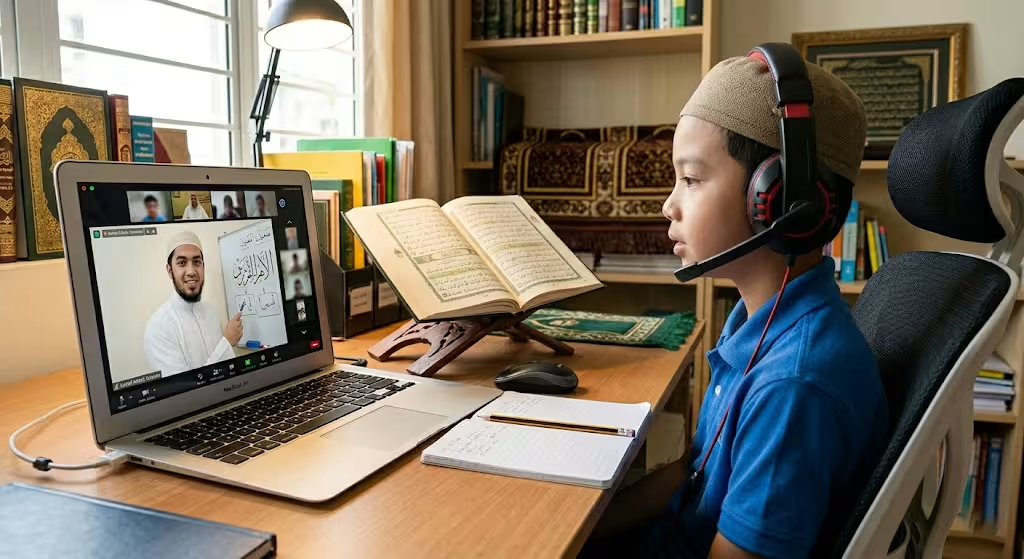
When you sign your child up for Quran lessons for kids, it is easy to lose track of what they are actually learning. One week it is letters, the next it is "page 14", and a few months later you are not sure whether your child is on track. A good Quran syllabus for children is not a mystery: it moves through clear stages, each with skills you can see and hear at home. This guide sets out what a strong syllabus looks like at each stage, mapped to the UK school years, with milestones, what a typical lesson includes, and simple checks parents can do without being Quran teachers themselves.
Why a Clear Syllabus Matters for Children
Many UK parents tell us the same story: their child attended classes for years but still reads slowly, because nobody tracked what was mastered and what was skipped. A clear syllabus prevents that. It gives the teacher a plan, gives the child small goals they can achieve, and gives parents a way to see progress. It also stops two common problems: moving on too fast (so mistakes become habits) and staying too long on one page (so children get bored).
The Five Stages at a Glance
| Stage | Typical UK school year | Main skills | Milestone |
|---|---|---|---|
| 1. Letters and sounds | Reception to Year 1 | Recognise the Arabic letters and say each sound correctly | Names and sounds every letter, in any order |
| 2. Qaida: joining and vowels | Year 1 to Year 3 | Joined letters, short and long vowels, tanween, sukoon, shaddah | Finishes Noorani Qaida and reads unfamiliar words slowly but correctly |
| 3. First Mushaf reading | Year 2 to Year 4 | Reading Juz Amma from the Mushaf, ghunnah, basic Madd, stopping at verse ends | Reads a short Surah from the page without spelling words out |
| 4. Fluency and Tajweed | Year 4 to Year 7 | Longer passages, noon and meem rules, qalqalah, heavy letters | Reads a full page fluently with the main rules applied |
| 5. Memorisation and meaning | Year 5 onwards | Memorising Surahs, revision, simple meanings and tafseer | Recites Juz Amma from memory, or starts a Hifz programme |
These year groups are typical, not fixed. A child who starts at nine may move through stages 1 and 2 much faster than a four-year-old, while some young children need extra time. Our guide on what age a child should start learning Quran explains the signs of readiness.
Stages 1 and 2: Letters, Vowels and the Qaida
The first two stages build the foundation everything else depends on. Children learn each letter's shape and sound, then how letters change shape when joined, then the vowel signs that turn letters into syllables. Most teachers use Noorani Qaida for this, and our Noorani Qaida lesson-by-lesson guide explains what each part teaches.
What a lesson looks like: a quick revision of the last page, five to ten minutes of new material, then reading practice where the child does most of the talking. For young children, lessons include a lot of praise, repetition and short breaks.
Parent check: point to letters on the page in random order. If your child answers instantly, the foundation is secure.
Stage 3: Reading From the Mushaf
Moving from the Qaida to the Quran itself is a big moment. Most children begin with the short Surahs of Juz Amma, which they may already know by ear. The teacher now introduces the most important early Tajweed rules: holding the nasal sound (ghunnah) on noon and meem with shaddah, stretching long vowels for two counts, and stopping correctly at the end of a verse.
Parent check: ask your child to read a verse they have not memorised. They should read it without spelling it out letter by letter, even if slowly.
Stage 4: Fluency and Tajweed
At this stage children read longer passages and apply more rules, such as the rules of noon sakinah and tanween, meem sakinah, qalqalah and heavy letters. Accuracy comes first, then speed. A good teacher introduces one rule at a time and keeps revising the earlier ones, so children do not feel overwhelmed. Our Tajweed course follows this step-by-step approach.
Parent check: listen to one page. The reading should flow, with long vowels clearly longer than short ones and a gentle nasal sound where needed.
Stage 5: Memorisation and Meaning
Memorisation does not have to wait until stage 5. Most children memorise short Surahs from the start, beginning with Al-Fatihah; our guide to short Surahs for kids to memorise first suggests an order. But once a child reads fluently, memorisation becomes more accurate and can grow into a structured programme. Older children also benefit from learning simple meanings, so the Surahs they recite in prayer make sense to them. Children ready for more can join our Quran memorisation course.
What Runs Alongside Every Stage
Parents often ask whether online Quran classes can also teach duas and Islamic manners. A complete syllabus for children always includes:
- Short Surahs for daily prayer, learned by ear and then from the page.
- Everyday duas, such as before eating, sleeping and leaving the house.
- Manners (adab): respect for the Quran, the teacher and parents.
- Basics of faith, taught gently and at the child's level.
These are covered in our Islamic Studies lessons and can be added to Quran lessons for kids at any stage.
How to Track Your Child's Progress
- Know the stage. Ask the teacher which stage and page your child is on, and what the next milestone is.
- Read the monthly progress report and compare it with the previous month.
- Record your child once a month reading the same short passage; the difference over a term is often striking.
- Sit in on a lesson now and then to see how your child is taught.
- Check the basics at home with the parent checks above.
If progress has stalled for more than a couple of months, talk to the teacher. Often a short revision period, a different lesson time or one more lesson a week is all that is needed. Our guide on how many Quran lessons a week can help you choose.
Choosing Quran Classes for Kids With a Clear Syllabus
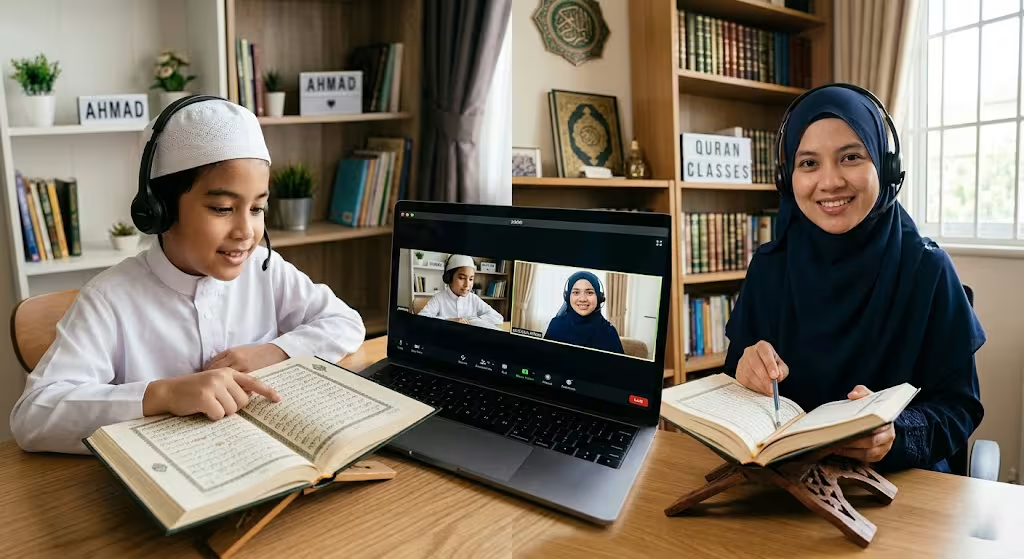
Before you enrol, ask any academy to explain its syllabus in the way set out above: the stages, the milestones and how you will see progress. A teacher who can tell you exactly where your child will start and what comes next is far more likely to get results. Parents also ask whether their child can learn with a qualified teacher online; in a live one-to-one lesson, the teacher hears every letter and corrects it straight away, which is exactly what each stage of this syllabus needs.
Our Quran classes for kids follow this stage-by-stage approach, with one-to-one 30-minute lessons taught by certified male and female teachers, timed around UK school hours. Parents are welcome to sit in, and every family receives a monthly progress report.
Frequently Asked Questions
What should Quran lessons for kids include?
Letters and sounds, Noorani Qaida, reading from the Mushaf, Tajweed introduced step by step, memorisation of short Surahs, and alongside these, everyday duas and Islamic manners.
How long does each stage take?
It varies with age and how often your child has lessons. Many children finish the Qaida in several months to a year, then spend longer building fluency and Tajweed.
Can online Quran classes also teach duas and manners?
Yes. Duas, manners and the basics of faith can be taught alongside Quran reading at every stage.
Can my child learn Quran online with a qualified teacher?
Yes. In live one-to-one online lessons a qualified teacher hears your child recite and corrects every mistake straight away.
Should my child start memorising before reading fluently?
Children can memorise short Surahs by ear from an early age, but a structured memorisation programme works best once they read fluently.
How will I know my child is making progress?
Ask which stage and milestone your child is working on, read the monthly progress report, and record your child reading once a month to compare.
 Kids
 Kids
 Kids