


Parents often ask when their child should start learning Tajweed, and whether the rules are too complicated for young children. The answer is reassuring: Tajweed for kids does not begin with rules at all. It begins with listening and copying correct sounds, long before a child could name a single rule. This guide explains what Tajweed means in simple words, the right order to introduce it at each age, playful ways to teach it at home, and how to tell whether your child's recitation is on track.
What Is Tajweed, in Simple Words?
Tajweed means reciting the Quran beautifully and correctly, the way it was taught by the Prophet Muhammad ﷺ. For a child, you can explain it like this: "Every letter has its own special sound and its own home in the mouth. Tajweed helps us say each letter properly, stretch some sounds, and make some sounds through the nose." That is enough for a young child to understand why the teacher keeps asking them to repeat a word.
When Should Children Start Tajweed?
| Age (approx.) | What Tajweed looks like |
|---|---|
| 4 to 6 | Copying the teacher's sounds exactly; correct letter sounds from day one; no rule names |
| 7 to 8 | First simple rules by name: holding the nasal sound, stretching long vowels for two counts, stopping at the end of a verse |
| 9 to 10 | The main rule families: noon sakinah and tanween, meem sakinah, qalqalah, the main types of Madd |
| 11 and over | Heavy and light letters, stopping and starting rules, applying everything consistently across a page |
Children who start later often move faster, because they understand explanations more easily. What matters is that rules come after the child can read smoothly. If your child is still on the Qaida, see our Noorani Qaida lesson-by-lesson guide and our guide to what age to start learning Quran.
The Right Order to Introduce Rules
- Correct letter sounds, especially letters that do not exist in English.
- Short and long vowels: short ones short, long ones held for two counts.
- Ghunnah: the nasal sound on noon and meem with shaddah.
- Stopping correctly at the end of a verse.
- Noon sakinah and tanween: see our guide to noon sakinah and tanween rules.
- Meem sakinah: our meem sakinah guide uses short Surahs children know.
- Qalqalah and the main types of Madd; see our Madd rules guide.
One new rule at a time, practised in Surahs the child already knows, works far better than a list of rules learned by heart.
Playful Ways to Teach Tajweed at Home
- "Nose or no nose?" Say a word and let your child guess whether it has a nasal sound. Then let them test you.
- Finger counting. Hold up two fingers for a two-count stretch and six for a long Madd; children love keeping count.
- Bouncing letters. Call the qalqalah letters "bouncy letters" and let your child bounce a ball each time they find one in Al-Ikhlas.
- Colour hunting. In a colour-coded Mushaf, hunt for one colour a week and say what it means.
- Record and listen. Children are often delighted to hear their own improvement after a few weeks.
Practise With Short Surahs They Already Know
Familiar Surahs are perfect for Tajweed practice because the child is not struggling to read the words. Al-Fatihah, Al-Ikhlas, Al-Falaq and An-Nas contain examples of almost every early rule. Our guide to short Surahs for kids suggests an order for memorising them.
Signs Your Child's Tajweed Is on Track
- Letters like ح, ع and ق sound clearly different from ه, ء and ك.
- Long vowels are clearly longer than short ones.
- You can hear a gentle nasal sound on noon and meem with shaddah.
- Your child stops at the end of verses rather than mid-sentence.
- They can tell you, in their own words, why a sound is stretched or nasal.
Tajweed for Kids Online: What a Lesson Looks Like
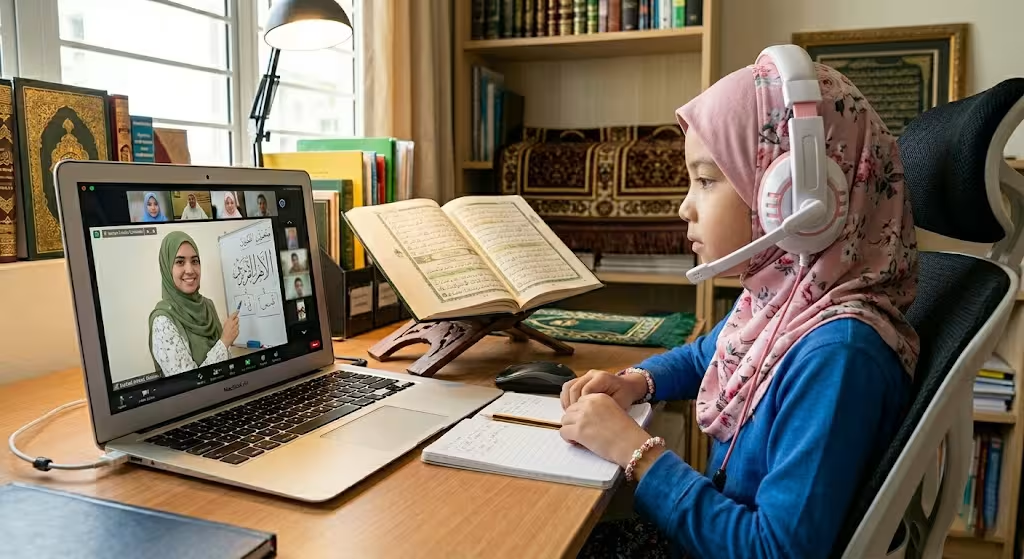
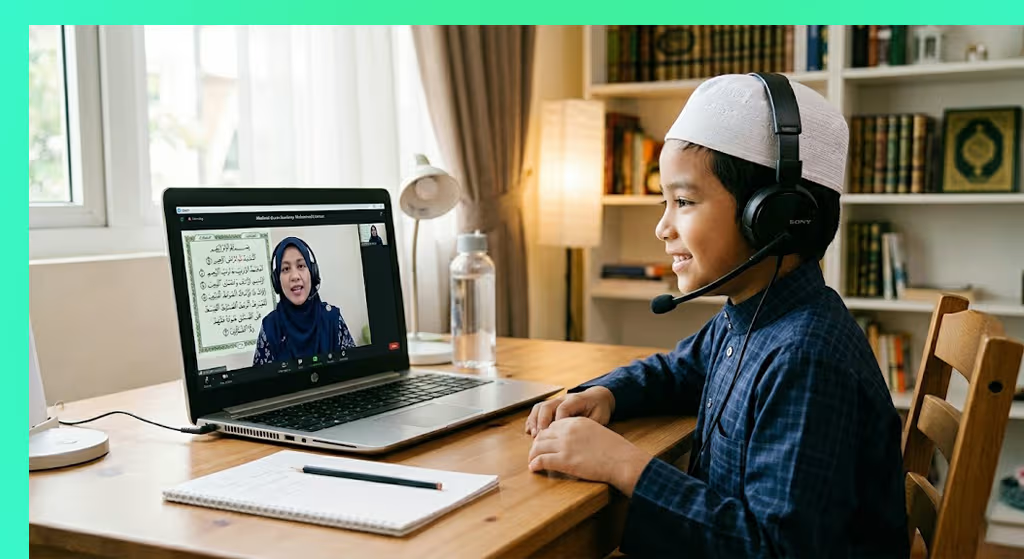
In a typical 30-minute online lesson for a nine-year-old, the teacher starts by listening to the child read the last passage, praising what went well. Next comes one small new idea, perhaps "today we listen for the nasal sound", demonstrated with two or three examples from a familiar Surah. The child then hunts for that sound on the page and reads each example back until it sounds right. The lesson ends with a tiny task, such as finding three more examples before the next class. Short, focused and positive lessons like this build accurate recitation without ever feeling like a grammar class.
Common Mistakes Parents Can Avoid
- Too many rules too soon. A seven-year-old does not need the names of every Idgham type.
- Speed over accuracy. Praise careful reading, not fast reading.
- Correcting harshly at home. Leave detailed correction to the teacher; at home, encourage.
- Stopping after the Qaida. Tajweed develops over years; keep lessons going once reading is fluent.
For more on keeping children engaged, read our guide on how to keep kids motivated in online Quran classes.
Frequently Asked Questions
What is Tajweed in simple words?
Tajweed means reciting the Quran correctly and beautifully: saying each letter from its proper place, stretching sounds where needed and stopping in the right places.
At what age should a child learn Tajweed?
Children copy correct sounds from their first lesson. Named rules usually start around 7 or 8, and the main rule families around 9 or 10, once reading is fluent.
How do I teach Tajweed to a young child?
Keep it playful: copy sounds, count stretches on fingers, hunt for "bouncy letters" and practise in Surahs your child already knows.
How can I teach a 4-year-old the Quran?
Focus on listening and repeating short phrases, learn a few letters at a time, and keep sessions to a few minutes with lots of praise.
Does my child need to learn the names of the rules?
Not at first. Correct sounds matter more than names. Names help older children understand and remember why they recite a certain way.
Can children learn Tajweed online?
Yes. In one-to-one online lessons the teacher hears every word and corrects it immediately, which suits Tajweed very well.
 Tajweed
 Kids
 Kids